藤岡 功筆頭の論文がAnnals of Hematologyに論文がacceptされました。CML患者におけるチロシンキナーゼ阻害剤治療においてはさまざまな有害事象が出現し、その一つが血管病変であり、治療成績に大きな影響をもたらします。その一方で、実臨床における発症率などの報告は数少なく、CML-CSGではデータベースを用いて解析を行いました。その結果、虚血性心疾患においてはnilotinib投与患者ので発症率が高く、経過観察において血管病変に注意が必要と思われました。
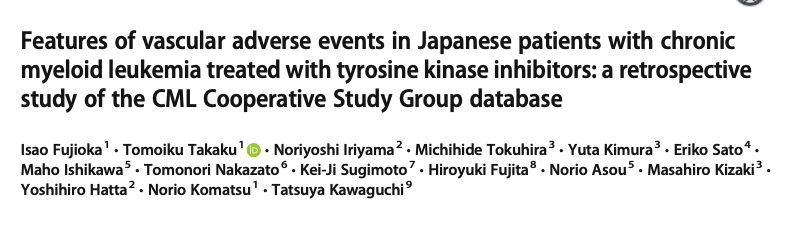
★ Features of vascular adverse events in Japanese patients with chronic myeloid leukemia treated with tyrosine kinase inhibitors: a retrospective study of the CML Cooperative Study Group database.
Ann Hematol. 2018 Nov;97(11):2081-2088. doi: 10.1007/s00277-018-3412-8.
Fujioka I, Takaku T, Iriyama N, Tokuhira M, Kimura Y, Sato E, Ishikawa M, Nakazato T, Sugimoto KJ, Fujita H, Asou N, Kizaki M, Hatta Y, Komatsu N, Kawaguchi T.
Abstract
This study investigated the incidence rate and features of vascular adverse events (VAEs) in Japanese patients with chronic myeloid leukemia (CML) who were treated with tyrosine kinase inhibitors (TKIs). The analysis included 369 CML patients in the chronic or accelerated phases, selected from the CML Cooperative Study Group database; 25 events in 23 (6.2%) of these patients were VAEs. At the time of VAE incidence, nine patients were on treatment with imatinib, 12 with nilotinib, three with dasatinib, and one with bosutinib. VAE incidence comprised 13 cases of ischemic heart disease (IHD), eight of cerebral infarction (CI), and four of peripheral arterial occlusive disease (PAOD). IHD incidence rate in the study population was higher than that in the age-matched general population, particularly in nilotinib-treated patients, while CI incidence rate was almost equivalent. Compared with the Suita score, the SCORE chart and the Framingham score risk assessment tools detected more patients with high or very high risk of VAEs. In conclusion, incidence of IHD requires closer monitoring in nilotinib-treated patients. More detailed investigations for determining the most useful tool to predict VAE incidence and long-term analysis of therapy-related VAE cases are needed for improving safety during TKI therapy.
pubmed: ここをクリック.
要旨
本研究では、チロシンキナーゼ阻害薬(TKI)による治療を受けた日本人慢性骨髄性白血病(CML)患者における血管有害事象(VAE)の発生率と特徴を検討した。解析対象は、CML Cooperative Study Groupデータベースから選択された慢性期または促進期のCML患者369人で、このうち23人(6.2%)の25イベントがVAEであった。VAE発生時、患者はイマチニブで9例、ニロチニブで12例、ダサチニブで3例、ボスチニブで1例の治療を受けていた。VAE発症の内訳は、虚血性心疾患(IHD)13例、脳梗塞(CI)8例、末梢動脈閉塞性疾患(PAOD)4例であった。IHD罹患率は年齢をマッチさせた一般集団よりも高く、特にニロチニブ投与群で高かったが、CI罹患率はほぼ同等であった。吹田スコアと比較して、SCOREチャートとフラミンガムスコアのリスク評価ツールは、VAEリスクが高いか非常に高い患者をより多く検出した。結論として、ニロチニブ治療患者におけるIHDの発生率は、より詳細なモニタリングが必要である。TKI治療中の安全性を向上させるためには、VAE発症を予測する最も有用なツールを決定するためのより詳細な調査と、治療に関連したVAE症例の長期的な解析が必要である。