入山規良筆頭の論文がInternational Journal of Hematologyにacceptされました。CML-CSGのデータベースを用いて、第一世代のチロシンキナーゼ阻害剤であるイマチニブ時代と、第二世代チロシンキナーゼ阻害剤が第一選択薬で行われている第二世代時代 (2G-TKI)でのデータ解析を行い、リスクスコアにおいて、前者では複数のスコアリングシステムが機能していましたが、2G-TKI時代ではELTSスコアのみが有効であることが示されました。CMLにおいては、特にELTSスコアを参考にして治療選択を考慮することが大切であることが示唆されました。
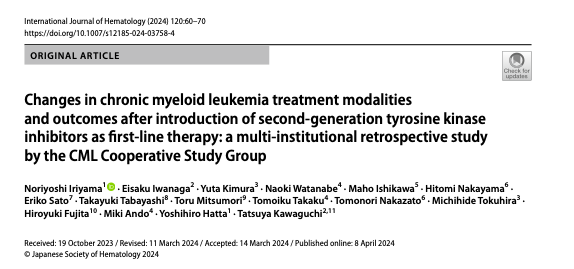
★ Changes in chronic myeloid leukemia treatment modalities and outcomes after introduction of second-generation tyrosine kinase inhibitors as first-line therapy: a multi-institutional retrospective study by the CML Cooperative Study Group
Int J Hematol.2024 Apr 8. doi: 10.1007/s12185-024-03758-4. (Online ahead of print)
Iriyama N, Iwanaga E. Kimura Y, Watanabe N, Ishikawa M, Nakayama H, Sato E, Takayuki T, Mitsumori T, Takaku T, Nakazato T, Tokuhira M, Fujita H, Ando M, Hatta Y, Kawaguchi T.
Abstract
This study investigated changes in treatment modalities and outcomes of chronic myeloid leukemia in the chronic phase (CP-CML) after the approval of second-generation tyrosine kinase inhibitors (2G-TKIs) for first-line therapy. Patients were grouped into those who underwent TKI therapy up to December 2010 (imatinib era group, n = 185) and after January 2011 (2G-TKI era group, n = 425). All patients in the imatinib era group were initially treated with imatinib, whereas patients in the 2G-TKI era group were mostly treated with dasatinib (55%) or nilotinib (36%). However, outcomes including progression-free survival, overall survival, and CML-related death (CRD) did not differ significantly between groups. When stratified by risk scores, the prognostic performance of the ELTS score was superior to that of the Sokal score. Even though both scoring systems predicted CRD in the imatinib era, only the ELTS score predicted CRD in the 2G-TKI era. Notably, the outcome of patients classified as high-risk by ELTS score was more favorable in the 2G-TKI era group than in the imatinib era group. Thus, expanding treatment options may have improved patient outcomes in CP-CML, particularly in patients classified as high-risk by ELTS score.
pubmed: ここをクリック
要旨
本研究では、第二世代チロシンキナーゼ阻害薬(2G-TKI)が第一選択薬として承認された後の、慢性期慢性骨髄性白血病(CP-CML)の治療法の変化と転帰について検討した。患者は、2010年12月までにTKI療法を受けた患者(イマチニブ時代群、n=185)と2011年1月以降にTKI療法を受けた患者(2G-TKI時代群、n=425)に分類された。イマチニブ時代群では全例がイマチニブによる初期治療を受けたが、2G-TKI時代群ではほとんどがダサチニブ(55%)またはニロチニブ(36%)による治療であった。しかし、無増悪生存期間、全生存期間、CML関連死(CRD)などの転帰に群間で有意差はなかった。リスクスコアで層別化すると、ELTSスコアの予後予測能はSokalスコアよりも優れていた。イマチニブ時代にはどちらのスコアリングシステムもCRDを予測したが、2G-TKI時代にはELTSスコアのみがCRDを予測した。注目すべきは、ELTSスコアによって高リスクに分類された患者の転帰は、イマチニブ時代よりも2G-TKI時代のグループの方が良好であったことである。従って、治療選択肢の拡大は、特にELTSスコアで高リスクに分類された患者において、CP-CMLにおける患者の転帰を改善した可能性がある。