入山 規良筆頭の論文が Medical Oncologyにacceptされました。第2世代チロシンキナーゼ阻害薬 (TKI) は第1世代TKIと比較して生存率、治療反応性も有意に成績を向上させましたが、第2世代チロシンキナーゼ阻害薬であるdasatinibとnilotinibの優劣に関してはほとんどデータがありませんでした。そこでCML-CSGのデータを用いて解析したところ、生存率、治療反応性いずれにもいても、双方とも良好な成績を示し、両群間で有意差を認めませんでした。
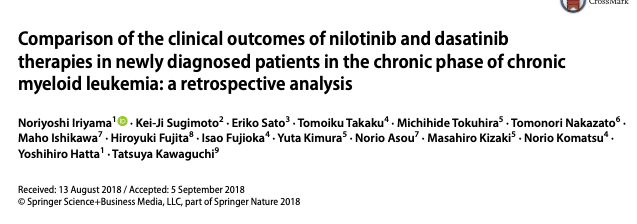
★ Comparison of the clinical outcomes of nilotinib and dasatinib therapies in newly diagnosed patients in the chronic phase of chronic myeloid leukemia: a retrospective analysis.
Med Oncol. 2018 Sep 7;35(11):142. doi: 10.1007/s12032-018-1203-7.
Iriyama N, Sugimoto KJ, Sato E, Takaku T, Tokuhira M, Nakazato T, Ishikawa M, Fujita H, Fujioka I, Kimura Y, Asou N, Kizaki M, Komatsu N, Hatta Y, Kawaguchi T
Abstract
Treatment with a tyrosine kinase inhibitor (TKI) is the standard of care for patients with chronic myeloid leukemia (CML). The new-generation TKIs, nilotinib and dasatinib, are found to have deeper and faster treatment response rates compared to imatinib in the first-line setting. However, a direct comparison between nilotinib and dasatinib has never been reported previously. Our study aims to compare the outcomes and molecular responses achieved following the first-line use of these two agents in patients with CML-CP. The database of the CML Cooperative Study Group was reviewed and patients with CML in the chronic phase (CP) who were given nilotinib or dasatinib as first-line therapy were identified. Out of 361 patients with CML-CP enrolled in our database, 58 and 63 had been treated with conventional doses of nilotinib (300 mg twice daily) and dasatinib (100 mg once daily), respectively, as first-line therapy. The patient demographics did not show significant differences between the groups. The event-free survival rates did not differ between these two groups. The major molecular response (MMR) and the deep molecular response (DMR) rates by 6, 12, 18, and 24 months did not differ between groups. Among the three scoring systems, only the Hasford score could predict the achievement of DMR, and all of them failed to predict the achievement of MMR in the entire cohort. Our data suggest that both nilotinib and dasatinib have comparable efficacies and promising outcomes.
pubmed: ここをクリック.
要旨
チロシンキナーゼ阻害薬(TKI)による治療は、慢性骨髄性白血病(CML)患者に対する標準治療である。新世代のTKIであるニロチニブおよびダサチニブは、一次治療においてイマチニブに比べてより深く、より速い治療奏効率を示すことが判明している。しかし、ニロチニブとダサチニブの直接比較はこれまで報告されていない。本研究の目的は、CML-CP患者におけるこれら2剤の初回使用後に達成された転帰と分子学的奏効を比較することである。CML Cooperative Study Groupのデータベースを検討し、一次治療としてニロチニブまたはダサチニブが投与された慢性期(CP)のCML患者を同定した。データベースに登録された361例のCML-CP患者のうち、58例と63例が、それぞれ従来用量のニロチニブ(300mgを1日2回)とダサチニブ(100mgを1日1回)を第一選択療法として投与されていた。患者の属性は両群間に有意差を示さなかった。無イベント生存率は両群間に差はなかった。6ヵ月、12ヵ月、18ヵ月、24ヵ月までの主要分子奏効(MMR)率および深部分子奏効(DMR)率に群間差はなかった。3つのスコアリングシステムのうち、DMRの達成を予測できたのはハスフォードスコアのみであり、全コホートにおけるMMRの達成を予測することはできなかった。このデータから、ニロチニブとダサチニブの有効性は同等であり、予後も有望であることが示唆される。