得平道英筆頭の論文がMedical Oncologyにacceptされました。第2世代チロシンキナーゼ阻害剤 (TKI)は第1世代TKIのイマチニブの成績を凌駕する事が明らかになっていますが、実臨床での成績は少なく、また投与量の調節の実際も不明な点が存在しています。そのためCML-CSGのデータベースを用いて第2世代TKIであるnilotinibの解析を行ったところ、治療反応性、無急性白血病率、および生存率などにおいて、これまでの前向き試験と同等以上の成績が得られたことを報告し、また通常量 (600mg/日)未満の投与量においても通常量と同等もしくはそれより優れた成績を示した事を合わせて報告いたしました。
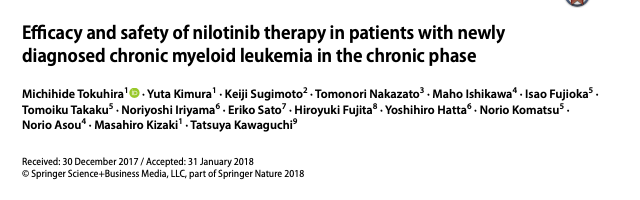
★ Efficacy and safety of nilotinib therapy in patients with newly diagnosed chronic myeloid leukemia in the chronic phase.
Med Oncol. 2018 Feb 13;35(3):38. doi: 10.1007/s12032-018-1093-8.
Tokuhira M, Kimura Y, Sugimoto K, Nakazato T, Ishikawa M, Fujioka I, Takaku T, Iriyama N, Sato E, Fujita H, Hatta Y, Komatsu N, Asou N, Kizaki M, Kawaguchi T.
Abstract
ABL1-tyrosine kinase inhibitors (TKIs) have led to dramatic changes in treatment strategies for chronic myeloid leukemia in the chronic phase (CML-CP). However, clinical studies have highlighted increasing numbers of adverse events (AE) with TKIs. Although TKI modification plays a key role in AE management, this process is poorly understood, particularly in terms of the TKI nilotinib. In the present study, we retrospectively analyzed the records of 70 patients with newly diagnosed (ND)-CML-CP who were treated with nilotinib to investigate the drug potency of nilotinib and treatment management. During a median observation period of 3.4 years, 76% of patients continued nilotinib as a first-line treatment. The 1-year and overall major molecular response (MMR) rates and the overall molecular response (MR) 4.5 rate for all patients receiving first-line nilotinib therapy were 70, 84.2, and 50%, respectively. No case progressed to the accelerated or blast phase during the study. To avoid AEs during the early phase, nilotinib doses were reduced to < 600 mg/day in a third of patients (Reduced group); these patients experienced better therapeutic efficacy and a lower rate of AEs relative to those in Standard group (300 mg twice daily). Ten patients who received < 600 mg/day of nilotinib throughout the study had a 1-year MMR rate and overall MR4.5 rate of 90 and 60%, respectively. In summary, our findings indicate that careful management, including dose reduction, can yield better outcomes in patients with ND-CML-CP.
pubmed: ここをクリック.
要旨
ABL1-チロシンキナーゼ阻害薬(TKI)は、慢性期の慢性骨髄性白血病(CML-CP)の治療戦略を劇的に変化させた。しかし、臨床研究において、TKIによる有害事象(AE)の増加が問題視されてきている。AE管理においてTKI調節は重要な役割を果たすが、特にニロチニブに関しては、この点において十分に解明されていな合。本研究では、ニロチニブの薬効と治療管理を検討するために、ニロチニブによる治療を受けた新規診断(ND-CML-CP患者70人を後方視的に解析した。観察期間中央値3.4年において、ニロチニブを第一選択薬として開始した76%の患者が継続していた。ニロチニブを一次治療として行った患者における、1年次主要分子奏効(MMR)率は70%、全MMR率は84.2%、全分子奏効(MR)4.5率は50%であった。試験期間中、加速期または芽球期に進行した症例はなかった。初期段階でのAEを回避するため、3分の1の患者ではニロチニブの投与量を600mg/日未満に減量した(減量群)。減量群は標準群(300mgを1日2回投与)に比べて治療効果が高く、AE発生率も低かった。試験期間を通じてニロチニブを600mg/日未満投与された10例の1年MMR率は90%、全MR4.5率は60%であった。以上の結果から、ND-CML-CP患者においては、減量を含む慎重な管理がより良い転帰をもたらすことが示された。