仲里朝周筆頭の論文がMedical Oncologyにacceptされました。チロシンキナーゼ阻害剤 (TKI)で治療されたCML患者における二次性発がんのまとまった報告は極めて少なく、CML-CSGのデータベースを用いて第2世代TKI使用患者の解析を行ったところ、二次性発がんの発生率は一般人と比較して同等の発症率であり、TKI治療中の二次性発がんの発生は、一般人と比較してその生存率や死亡率に影響を与えませんでした。
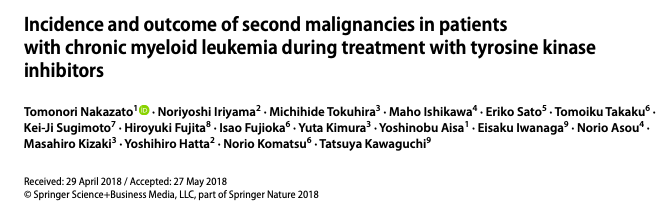
★ Incidence and outcome of second malignancies in patients with chronic myeloid leukemia during treatment with tyrosine kinase inhibitors.
Med Oncol. 2018 May 30;35(7):99. doi: 10.1007/s12032-018-1159-7.
Nakazato T, Iriyama N, Tokuhira M, Ishikawa M, Sato E, Takaku T, Sugimoto KJ, Fujita H, Fujioka I, Kimura Y, Aisa Y, Iwanaga E, Asou N, Kizaki M, Hatta Y, Komatsu N, Kawaguchi T.
Abstract
We performed a retrospective study to evaluate the incidence of second malignancies (SMs) in chronic myeloid leukemia (CML) patients treated with tyrosine kinase inhibitors (TKIs). We analyzed data from 339 patients with CML who were extracted from the CML Cooperative Study Group database. The standardized incidence ratio (SIR) was calculated to assess the risk of SMs using data from the Cancer Registries in Japan. The median follow-up was 65 months. SMs developed in 14 patients (4.1%, 10 men, 4 women) after the start of TKIs. The median age was 69 years at the time of the CML diagnosis and 72.5 years at the time of the SM diagnosis. Ten patients were treated with imatinib, three with dasatinib, and one with nilotinib as the initial treatment. The SIR for all malignancies was 1.05 (95% CI 0.50-1.93) for men and 1.08 (95% CI 0.29-2.76) for women. The difference in the overall survival (OS) of patients with or without SMs was not statistically significant (5-year OS: 82.5% vs. 92.9%; p = 0.343). A subgroup analysis of 166 patients treated with second-generation TKIs (92 dasatinib, 74 nilotinib) showed that the SIRs for all malignancies were 1.33 (95% CI 0.36-3.41) for men and 0 for women. In conclusion, the incidence of SMs in CML patients during TKI treatment was the same as that in the general Japanese population. There was no evidence of an increase in the incidence of SMs during second-generation TKI treatment. Furthermore, the occurrence of SMs during TKI treatment did not affect the survival or mortality in our cohort.
pubmed: ここをクリック.
要旨
チロシンキナーゼ阻害薬(TKI)による治療を受けた慢性骨髄性白血病(CML)患者における二次悪性腫瘍(SM)の発生率を評価するために、後方視的研究を行った。CML Cooperative Study Groupデータベースから抽出したCML患者339例のデータを解析した。SMのリスクを評価するために、日本のがん登録のデータを用いて標準化発生率比(SIR)を算出した。追跡期間中央値は65ヵ月であった。SMはTKI開始後14例(4.1%、男性10例、女性4例)に発症した。年齢中央値はCML診断時69歳、SM診断時72.5歳であった。初回治療としてイマチニブが10例、ダサチニブが3例、ニロチニブが1例であった。全悪性腫瘍のSIRは、男性で1.05(95%CI 0.50-1.93)、女性で1.08(95%CI 0.29-2.76)であった。SMの有無による全生存期間(OS)の差は統計学的に有意ではなかった(5年OS:82.5%対92.9%;p = 0.343)。第二世代TKIによる治療を受けた患者166人(ダサチニブ92人、ニロチニブ74人)のサブグループ解析では、全悪性腫瘍のSIRは男性で1.33(95%CI 0.36-3.41)、女性で0であった。結論として、TKI治療中のCML患者におけるSMの発生率は、日本の一般集団と同じであった。第二世代TKI治療中にSMsの発生率が増加したという証拠はなかった。さらに、TKI治療中のSMsの発生は、我々のコホートにおける生存率や死亡率に影響しなかった。